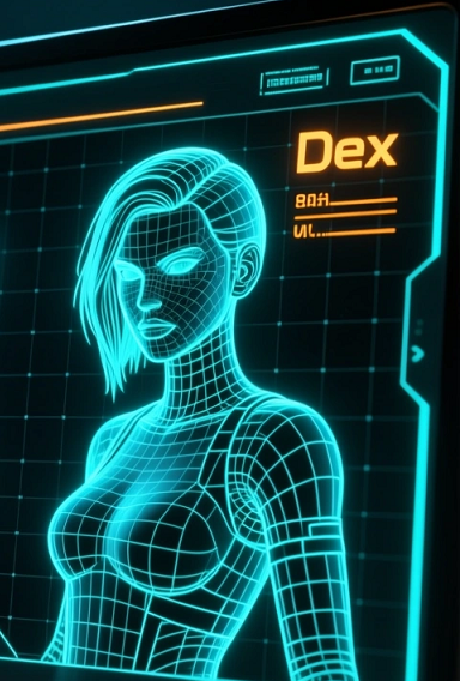
Field Notes from Hex Morrow
Let me tell you what most explainers get wrong about LitRPG.
They lead with the game mechanics. Stats, levels, skill trees, experience points. They make it sound like someone took a spreadsheet and stapled a story to it. They’re not wrong exactly, but they’re starting in the wrong place — like explaining a knife by describing the handle.
Start here instead: LitRPG is fiction about people who suddenly have information about themselves they didn’t have before.
A number floats in front of your face. It says you have 14 Strength and 7 Charisma and 312 Health Points remaining. You didn’t ask for that information. You didn’t install anything. The world just started telling you things about yourself in a language you don’t fully understand yet — and now you have to figure out what to do with it.
That’s the actual hook. Not the numbers. The reckoning.
The Genre That Ate Itself and Got Better
LitRPG started in eastern European web fiction around 2010 and spent several years being exactly as clunky as you’d expect from a genre finding its legs. Early entries were basically wish fulfillment delivery systems — protagonist wakes up in a game world, turns out to be secretly overpowered, accumulates skills and followers and wins.
Fine. Crowd pleasing. Not what I’m writing.
What the genre figured out over time is that the mechanics are a lens, not a plot engine. When a character gains a level, the interesting question isn’t what new power do they get — it’s who do they become. When the system tells you your Deception skill just hit 40, that’s not a reward. That’s a mirror.
The best LitRPG uses game logic the way noir uses weather: as atmosphere that tells the truth about everything else.
Why Cyber-Noir and LitRPG Belong Together
Nobody asked for this combination. I made it anyway.
Here’s the thing about noir: it’s always been about systems. Corrupt ones. Systems that were supposed to protect people and decided somewhere along the way that protection was less profitable than control. Detectives in noir don’t solve crimes so much as they read the system — follow the money, follow the power, figure out who the machine is actually serving.
LitRPG is literally about a world that runs on a visible system. Stats, classes, dungeons — it’s all infrastructure. Someone built it. Someone maintains it. Someone benefits from how it’s designed.
Put those two things together and you get the question I actually want to ask: what happens when the system has bugs?
Enter the Bug Hunter
Maya Chen didn’t choose her class. Nobody chooses their class — the system assigns it based on something it sees in you that you might not see yourself. Most people get Fighter or Mage or Rogue or any of a hundred variations on those themes. Useful classes. Legible classes. Classes with clear upgrade paths and established guild structures and equipment loadouts going back generations.
Maya got Bug Hunter.
There’s no guild for Bug Hunters. There’s no established loadout. There’s barely a description in the system registry — just a notation that Bug Hunters can read world error logs, which sounds about as useful as being able to smell WiFi signals.
Except the world has errors. A lot of them. And some of those errors are very, very old — and very, very deliberate.
That’s where Bug Hunter starts. Not with a hero who’s secretly the chosen one. With a woman who got handed a class nobody wanted, in a world that runs on rules nobody fully understands, and decided that not understanding the rules was actually the most interesting place to start.
So Should You Read LitRPG?
If you like systems — how they’re built, who they serve, what happens when they break — yes.
If you like characters who figure things out rather than characters who are simply powerful — yes.
If you’ve ever looked at a piece of software and thought someone made a choice here and it wasn’t a good one — absolutely yes.
If you want the fantasy equivalent of a cozy mystery where the stakes are low and everyone ends up fine — read something else. I mean that kindly. Bug Hunter is not that.
The world Maya is reading has errors that bleed. The logs she’s parsing have entries that were never supposed to be found. And the class she was assigned? The system didn’t create it by accident.
Nothing in a well-designed system is ever an accident.
Bug Hunter Vol. 1 — Null Pointer Merchant, Memory Leak Forest, Thread Deadlock Dungeon — is serializing now on Royal Road and Scribble Hub.